
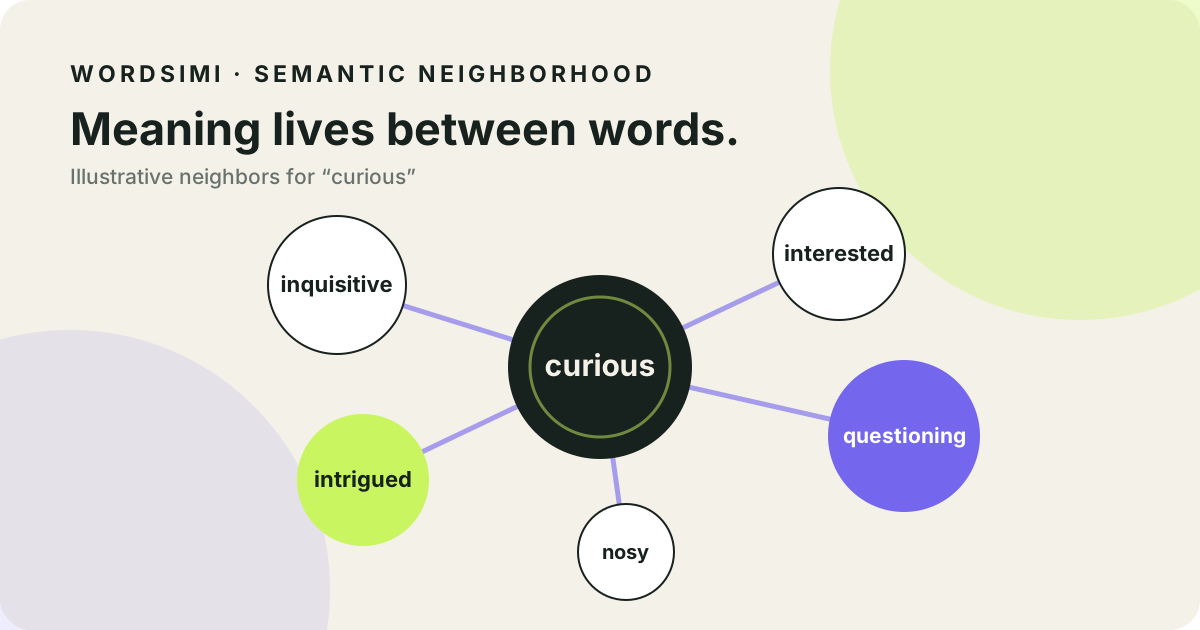
Sometimes you need a synonym. Other times, you need to see the territory around an idea.
Imagine that you are writing about curiosity. A thesaurus can offer interest, inquisitiveness, or wonder. Those substitutions are useful, but they answer a narrow question: which words can play a similar grammatical or dictionary role? A semantic word map asks a broader question: which words live near this idea in the patterns of language?
That is what semantic word similarity helps you explore. WordSimi takes a seed word and returns nearby words from a 400,000-word, 50-dimensional vector space. The result is not a definition and it is not a promise that every neighbor can replace the seed in a sentence. It is a quick view of the seed word’s neighborhood.
What semantic word similarity measures
A word vector represents a word as a list of numbers learned from language data. Words used in related contexts tend to receive vectors that point in related directions. A similarity search compares those positions and finds the closest candidates.
The important part is the source of the relationship: usage patterns. Doctor may sit near physician, but it may also be close to hospital, nurse, or patient. Those words are connected by context even though they are not interchangeable.
This makes a semantic neighborhood useful for discovery. It can surface:
- Direct synonyms and near-synonyms.
- Broader or narrower concepts.
- Terms from the same topic or profession.
- Words with a related tone or typical context.
- Unexpected associations worth investigating.
Similarity is therefore a signal, not a verdict. A short geometric distance means the model placed two words close together. You still decide what that relationship means for your task.
How this differs from spelling similarity
Words can look alike and mean very different things. Stationary and stationery are almost identical on the page, but one describes something that does not move and the other names writing materials. An edit-distance tool sees a close match. A semantic model should place them according to their use.
The opposite is also true. Rapid and swift do not share many letters, but their meanings often overlap. Semantic search can connect them because it is comparing learned language positions rather than characters.
This distinction matters whenever your starting point is an idea rather than a misspelling. Spell-checking asks, “Which written word did you probably intend?” WordSimi asks, “Which learned word positions are nearest to the word you supplied?”
How this differs from a thesaurus
A good thesaurus is edited around lexical relationships: synonym, antonym, related term, and sometimes usage. Its structure is deliberate and human-readable. A vector neighborhood is computed from a model, so it is broader, faster to query at scale, and sometimes messier.
Use a thesaurus when you need a carefully categorized replacement. Use a semantic map when you want to expand the search space.
For example, a writer naming a feature around clarity might already know the synonyms lucidity and plainness. A semantic neighborhood could also point toward precision, transparency, focus, or domain-specific words that suggest a different naming direction. Some results will fit. Some will merely reveal the shape of the topic.
The most productive workflow is often:
- Search the seed word.
- Notice two or three promising directions.
- Check definitions and real usage.
- Test candidates in the sentence or name.
WordSimi handles the expansive second step. Dictionaries, corpora, and your own judgment handle validation.
Read distance as relative, not absolute
WordSimi displays a distance for each result. Smaller values are closer in the indexed vector space. The useful comparison is usually within one result list: which candidates are nearer than the others for this seed?
Do not turn a distance into a universal percentage of sameness. The value depends on the model, its dimensions, normalization, and the approximate-nearest-neighbor search. A distance from one system is not automatically comparable with a score from another.
Approximate search is an intentional trade. WordSimi uses HNSW, a graph-based method that avoids comparing your seed against every vector on every request. It aims to find a very good neighborhood with much less work. For exploration, that speed-versus-exactness balance is usually the right one.
Try searches that reveal different relationships
Start with a familiar word so you can judge the neighborhood. Then change the kind of seed:
- An emotion such as serene or restless.
- A role such as architect or mentor.
- An abstract idea such as fairness or momentum.
- A concrete object such as harbor or lantern.
- A tone word such as playful or formal.
Look for patterns before hunting for one perfect result. Are the neighbors mostly synonyms, topic companions, names, technical terms, or morphological variations? That pattern tells you what the vector space has learned around the seed.
If your goal is practical writing or naming, continue with using word neighborhoods for writing and naming. If you are curious about how the graph fits into edge infrastructure, read how WordSimi runs HNSW-WASM on Cloudflare Workers.
Explore one real word
Choose a word from work you are already doing: a sentence that feels flat, a product name that is too generic, or a concept you are learning. Search it, scan the nearest words, and follow one direction you did not expect.
Open WordSimi and explore the neighborhood. The tool is free to use, and the approximate results are designed for discovery rather than pretending language has one exact map.
Continue in WordSimi
Test the idea with a word from your own work.
Search one seed word, inspect the nearest semantic neighbors, and validate the promising directions in a dictionary or your draft.

Written by
App Cradle Editorial Team
The App Cradle team writes from hands-on product work in quote discovery, writing tools, and semantic language exploration.
Continue learning
Take the next useful step.
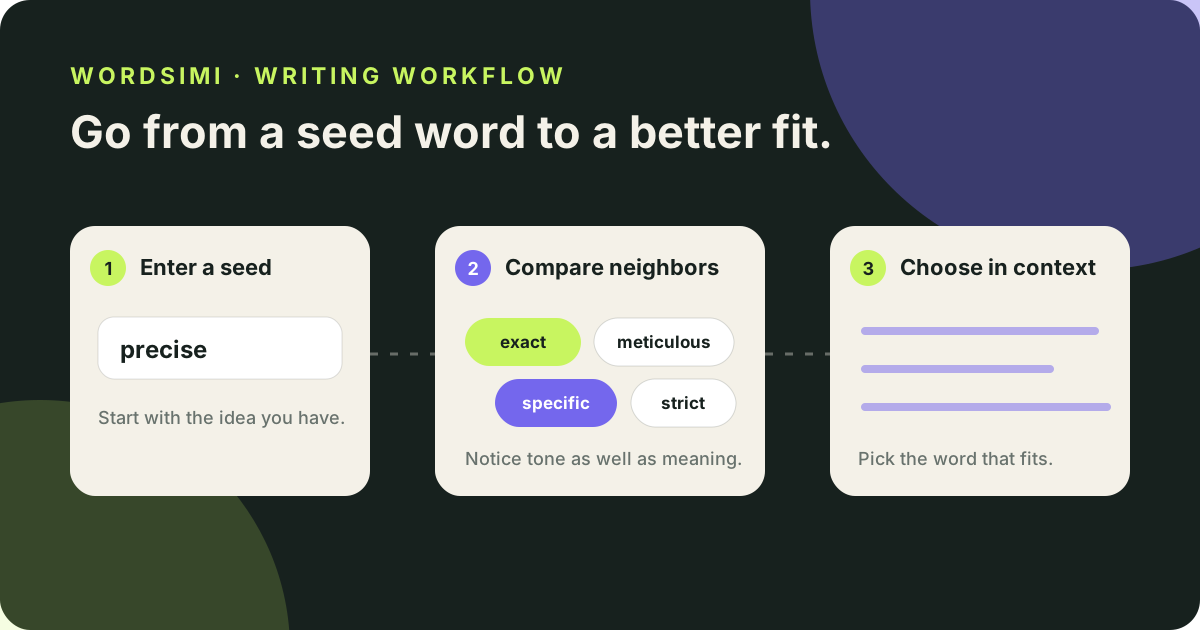 Writing Workflow
How to Use Word Neighborhoods for Writing and Naming
A practical workflow for using semantic word neighborhoods to improve phrasing, brainstorm names, expand vocabulary, and escape obvious synonyms.
Read the guide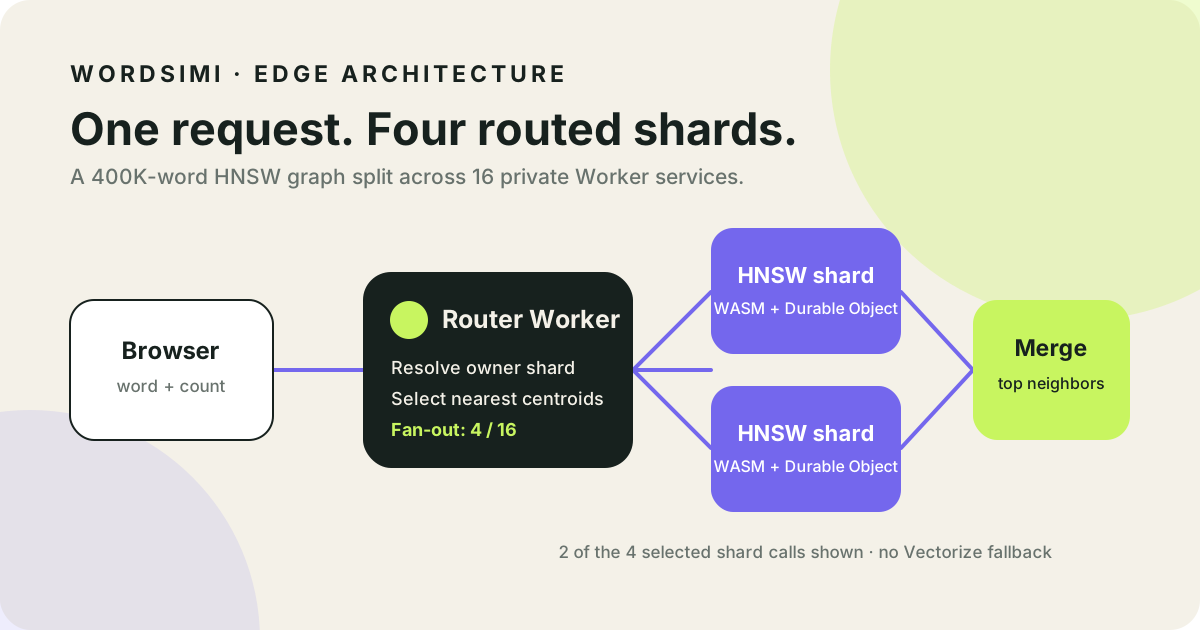 Edge Architecture
How WordSimi Runs HNSW-WASM on Cloudflare Workers
An engineering tour of WordSimi's sharded HNSW-WASM search: 16 private shards, four-shard routing, Durable Objects, caching, and no Vectorize fallback.
Read the guide