What you will be able to do
Use this guide to make a better decision.
- Define the quotation's job before opening a search tool.
- Separate discovery from verification and trace important wording to a reliable source.
- Choose and place the line by testing it inside the real paragraph, slide, or speech.
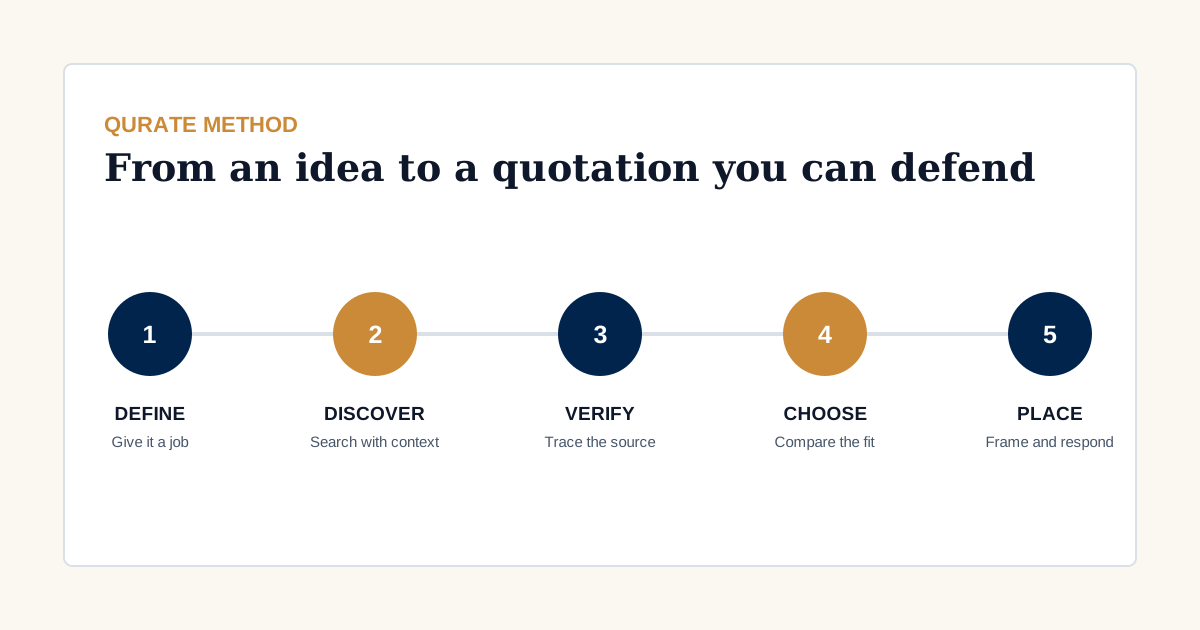
Finding a quotation is not one task. It is a chain of decisions: deciding what the borrowed words should do, discovering candidates, checking the source, understanding the context, choosing among similar options, and placing the final line without surrendering the paragraph to it.
When those decisions are collapsed into one search box, the process feels random. You browse a page of memorable lines, choose the one that sounds strongest, and only later discover that it does not fit the audience or cannot be traced to its supposed author.
A better method separates discovery from proof. Use a quote finder to explore possibilities. Use original works, archives, and authoritative references to verify them. Then use your own judgment to decide whether the line belongs.
1. Give the quotation one job
Begin with the sentence you want the audience to understand. This is your point, and it should exist before the quotation.
Then decide what borrowed words could contribute that your current draft cannot. A quotation can:
- Open a subject with energy or tension.
- Give compact language to an abstract idea.
- Add a credible outside perspective.
- Complicate an argument that feels too simple.
- Create a transition or moment of reflection.
- Leave the audience with a memorable final frame.
“I need a quote about leadership” gives you a topic. “I need a brief, plainspoken line that challenges a leadership team to listen before making a decision” gives the quote a job.
Write the job in one sentence:
I need a [tone] quotation to [job] a [format] for [audience] about [idea].
That sentence becomes both a search prompt and a standard for rejecting results.
2. Search by situation and meaning
Exact-word search is useful when you remember part of the wording or know the author. It is weaker when you know the thought but not the sentence.
For discovery, describe the full situation:
- Idea: rebuilding trust after a difficult decision.
- Format: an all-hands speech.
- Audience: a tired product team.
- Job: create a transition from acknowledging the problem to discussing the work ahead.
- Tone: candid and hopeful, without sounding triumphant.
Combined prompt:
A candid, hopeful quotation to transition an all-hands speech for a tired product team from acknowledging a difficult decision to rebuilding trust.
This approach does not guarantee a perfect result. It does something more useful: it tells you why a candidate is wrong. A line can miss the tone, audience, job, or idea. That is much easier to act on than “I just don’t like it.”
Use the quote-search prompt builder to shape this sentence, or read the deeper explanation of semantic quote search.
3. Keep a short, diverse shortlist
Do not choose the first acceptable result. Save three to five candidates that solve the job in different ways.
One might be direct. Another may use an image or metaphor. A third may challenge the premise instead of supporting it. Diversity makes comparison possible; five versions of the same familiar line do not.
Record enough information to investigate each candidate:
| Candidate | Attributed author | Claimed source | Why it might fit | What needs checking |
|---|---|---|---|---|
| A | Name | Speech or book | Clear and concise | Exact wording |
| B | Name | Unknown | Better emotional tone | Author and source |
| C | Name | Interview | Useful tension | Full surrounding passage |
Treat “source unknown” as a research flag, not a small formatting inconvenience.
4. Verify the wording and attribution
Quote discovery tools, social posts, image cards, and general quotation websites are starting points. They are not all equally strong evidence for who said something, when it was said, or whether the circulated wording is accurate.
The Library of Congress guide to finding quotations recommends tracing quotations with reference works, original documents, full-text collections, and deliberate search techniques. Its section on quotations and misquotations explains why even familiar attributions deserve care.
Use this verification sequence:
- Search the distinctive part of the quotation inside quotation marks.
- If the exact wording fails, break it into shorter distinctive phrases.
- Look for the earliest reliable appearance you can access.
- Prefer the original book, speech transcript, interview, letter, recording, or institutional archive.
- Compare the circulated wording with the source.
- Record the title, date, page, timestamp, or stable URL needed for attribution.
The Library of Congress also maintains a useful list of free online quotation research resources, while warning that a quotation website without an original citation should remain a lead rather than the final authority.
If the attribution cannot be verified, you have three honest options: choose another quotation, describe the attribution as uncertain when that uncertainty matters, or use the underlying idea in your own words without presenting the disputed line as verified fact.
5. Read enough context to avoid changing the meaning
Accurate wording can still be misleading when removed from its original setting. A sentence may be ironic, spoken by a fictional character whose view the author rejects, answered in the next paragraph, or limited to circumstances that disappear when the line is isolated.
Read before and after the quotation. For a speech or interview, listen to the surrounding minute. Ask:
- Who is speaking, and in what role?
- What question or problem are they responding to?
- Is the sentence sincere, ironic, hypothetical, or quoted from someone else?
- Does the next sentence qualify it?
- Would the original speaker recognize your use as a fair representation?
You do not need to reproduce the entire background for the audience. You do need enough context to use the line honestly.
6. Choose the quote that helps your point
Now compare the verified candidates inside the real work. Paste each one between the sentence before it and the sentence after it. For a speech, read the passage aloud. For a slide, view it from a distance.
Judge each candidate on six dimensions:
- Relevance: it directly supports or usefully complicates your point.
- Source confidence: the wording and attribution are traceable.
- Context: your use does not reverse the original meaning.
- Tone: it fits the audience and emotional temperature.
- Placement: it strengthens the surrounding material.
- Length: it is concise enough for the format.
The quote-fit checklist turns those questions into a quick scorecard. Relevance and source confidence are gates, not bonus points. A short, elegant line with an uncertain source is still a weak choice for work where accuracy matters.
7. Introduce, quote, and respond
The reader should never have to guess why the quotation appeared.
A reliable paragraph pattern has three moves:
- Introduce: name the speaker or source and tell the reader what to notice.
- Quote: include only the wording needed for the point.
- Respond: explain how the line supports, challenges, or changes your argument.
The final move is what keeps your thinking in charge. A quotation is evidence or perspective; it is not analysis by itself.
Citation format depends on the context. Academic work may require MLA, APA, Chicago, or a house style. The MLA Style Center and Purdue OWL’s research and citation resources are stronger references for formatting than a generic quote page.
For non-academic work, give the audience enough information to understand the source and find it when appropriate. A speaker’s name alone may be sufficient on a clean presentation slide, while an article can link to the original transcript or publication.
A complete workflow you can reuse
Before publishing or presenting, run this sequence:
- Write your point in your own words.
- Give the quotation one job.
- Search with idea, format, audience, job, and tone.
- Save three to five meaningfully different candidates.
- Verify wording, attribution, and original source.
- Read enough context to confirm fair use.
- Test each candidate inside the real passage.
- Choose using relevance, source, context, tone, placement, and length.
- Introduce the quotation and respond in your own voice.
- Cite it according to the requirements of the work.
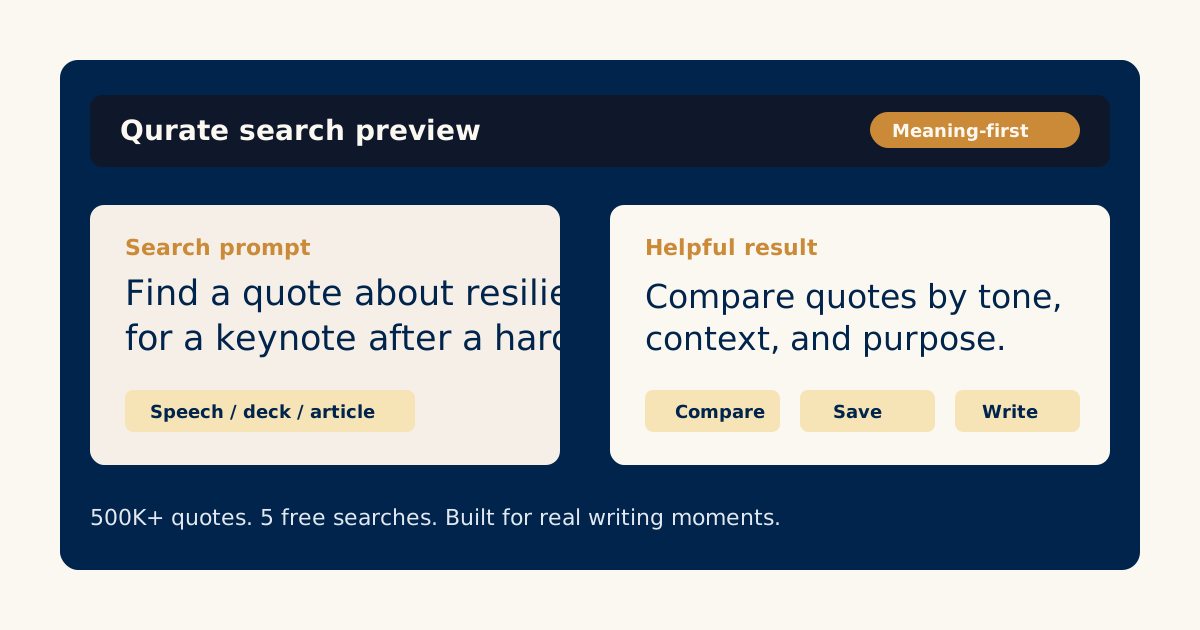
Qurate can make the discovery part faster by letting you search a 500K+ quote library with the context of the writing problem. It does not remove the verification or judgment steps, and a responsible workflow should not pretend otherwise.
Start with the work you already have
Open the speech, article, essay, deck, or message where the quotation will live. Write the job sentence first, then search.
Search Qurate with five free searches, shortlist a few candidates, and bring the strongest one back through the verification and fit checks above.
Continue in Qurate
Search with the context you have already worked out.
Bring the idea, audience, setting, and tone from this guide into Qurate, then compare the matches in your actual draft.

Written by
App Cradle Editorial Team
The App Cradle team writes from hands-on product work in quote discovery, writing tools, and semantic language exploration.
Continue learning
Take the next useful step.
 Quote Search
Semantic Quote Search: Find Quotes by Meaning, Not Just Keywords
A human guide to semantic quote search: how to find quotes by meaning, tone, and context when exact keywords are not enough.
Read the guide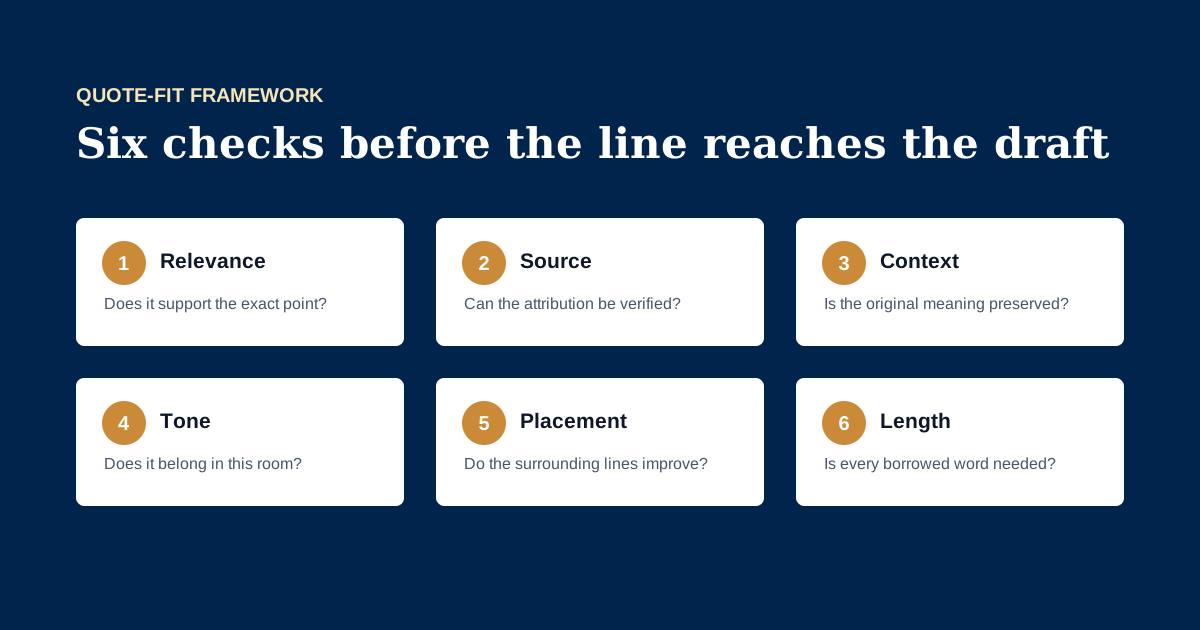 Writing Judgment
How to Choose a Quote That Actually Supports Your Point
Use a six-part quote-fit test to choose a relevant, credible quotation that strengthens your argument instead of merely sounding impressive.
Read the guideWritingHow to Use Quotes in Articles Without Sounding Generic
Learn how to use quotes in articles with better judgment, stronger framing, and less of that pasted-in internet quote feeling.
Read the guide